
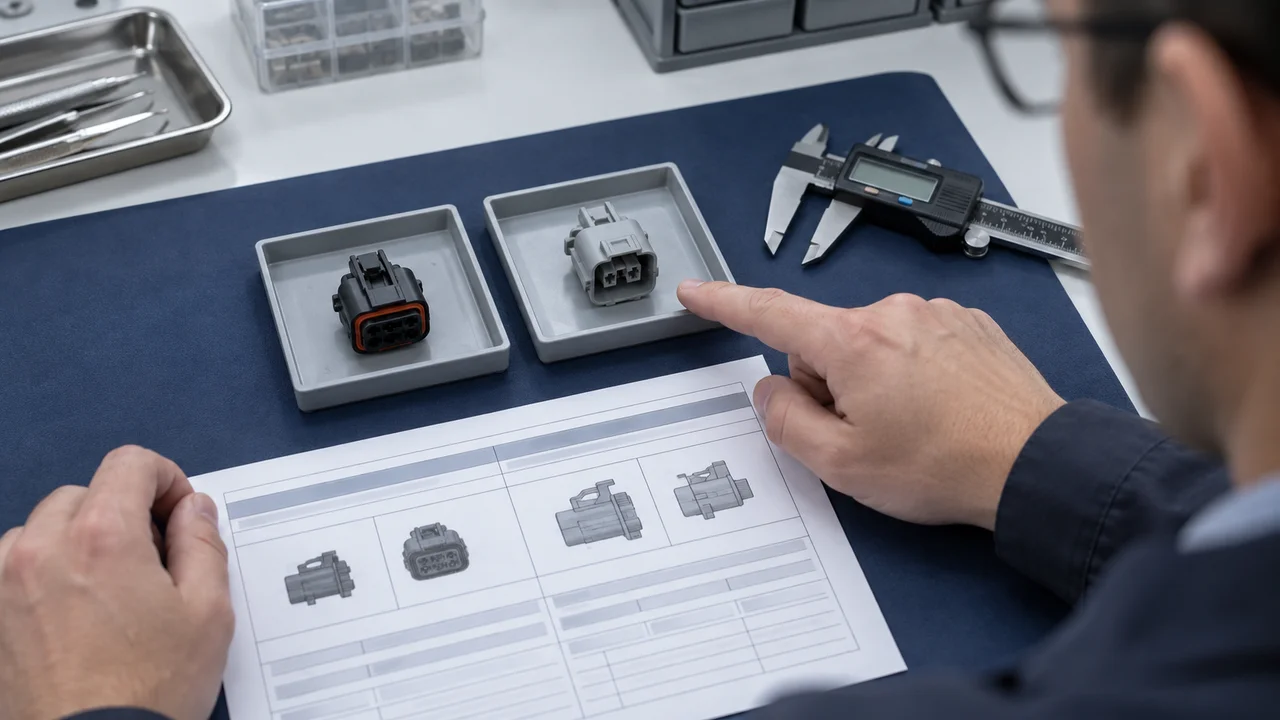
An alternative assessment should start with the original design's fixed requirements, not a search for a connector that looks similar. A Chinese-brand candidate may meet a sourcing preference, but its suitability still depends on the mechanical interface, electrical conditions, mating components and assembly process. The framework below supports candidate evaluation; it does not recommend a specific cross-reference or imply that a candidate has completed project validation.
1. Define what “replacement” is allowed to change
One project may permit replacing only a connector. Another may allow both mating parts, the cable or harness, or even the PCB layout to change. These are different tasks with different validation scopes and should be distinguished before an inquiry begins.
Identify the original manufacturer, complete part number, mating parts, PCB or harness revision and actual operating conditions. Classify constraints as fixed, adjustable within an agreed range, or unresolved. For example, the footprint may be fixed while actuator color is negotiable; alternatively, the board connector may change while the customer's existing harness must remain untouched.
Define the sourcing requirement as well. Does “Chinese alternative” mean a Chinese-brand product, a particular manufacturing location, specified material origins or inclusion on a customer-approved list? Brand identity does not establish every origin-related condition. Specify any required evidence separately.
2. Compare interfaces before comparing overall appearance
Review the mating interface first, the mounting interface second, and the enclosure and operating space third. The mating interface includes contact positions, polarization, keying and retention. The mounting interface includes pads, holes, locating posts and hold-downs. Operating space includes the insertion path, actuator movement and harness loading.
Review the full mating system. A wire-to-board alternative involves the housing, contacts and board header. A board-to-board alternative involves both sides of the pair. JST and Samtec document these components or combinations separately, so an outline comparison of one part cannot establish interchangeability.[1][2]
Compare drawings feature by feature using common datums. Two images with similar overall dimensions do not establish identical interfaces. Leave missing critical dimensions and tolerances unresolved rather than estimating them from pictures.
3. Compare electrical and process data on equivalent terms
A higher headline current rating does not necessarily make a candidate more suitable. Check whether the tested configuration, wire, simultaneous loading and temperature conditions are comparable. Read voltage, contact resistance, durability and environmental data together with their qualifiers.
For example, the QSH/QTH specification explicitly defines the mating-height configuration covered by its general information.[3] The comparison principle is straightforward: test results for one configuration do not establish performance for another configuration outside the stated scope.
Match material, plating and process information to the complete candidate part number. The project team should confirm compatibility with the intended soldering, cleaning and assembly processes. A common industry practice is not evidence that a particular candidate has that characteristic.
4. Keep document comparison and physical testing separate
Use document statuses such as “confirmed,” “difference identified” and “to be confirmed.” Record physical testing separately as “not tested” or “specified tests completed,” with the supporting record. A confirmed document entry does not mean the candidate has passed testing.
| Review item | Document comparison record | Testing and follow-up |
|---|---|---|
| Original and candidate identity | Full part numbers, revisions and mating components: ______ | Sample identification and lot: ______ |
| Mating and mounting interfaces | Status, similarities or differences, and source location: ______ | Checks, methods and records: ______ |
| Electrical and environmental | Status, comparable conditions and evidence gaps: ______ | Operating conditions, acceptance criteria and owner: ______ |
| Materials and processing | Status, process differences and missing information: ______ | Soldering, crimping or assembly validation: ______ |
| Project approval | Whether fixed requirements are met: ______ | Approver, revision and approved scope: ______ |
Illustrative example—not a real part comparison or completed project: drawings confirm equal pitch and position count, but the hold-down locations differ and vibration information is unavailable. The record should say “pitch and count: confirmed; hold-downs: difference identified; vibration evidence: unresolved; physical testing: not performed.” Calling the candidate “basically compatible” loses essential information.
A “confirmed” status must state what was confirmed. Confirming the existence of a dimensional difference is not the same as confirming that the requirement is met. A precise written conclusion is more useful than an unexplained green check mark.
5. Convert remaining questions into validation tasks
Address differences affecting fixed constraints first. A candidate that requires a PCB change cannot remain an unchanged-board option when the project prohibits redesign. Remove it from that shortlist or obtain approval to revise the requirement; an attractive price does not resolve the conflict.
For candidates that remain, define risk-appropriate sample, assembly, electrical and environmental checks. Record the samples and revisions, conditions, method, acceptance criteria, responsible person and open issues. Without actual test records, an external response should describe the planned work, not present it as completed.
Passing selected sample checks does not prove suitability for all future lots or operating conditions. Production introduction remains subject to the project owner's design-change and quality approvals. Supplier documentation does not replace the customer's internal release decision.
6. Deliver a difference assessment—not just another part number
A useful alternative proposal identifies the original and candidate precisely, lists the documents reviewed, separates established facts from differences and evidence gaps, and defines validation work and the limits of the conclusion. Cost and lead time can inform the decision, but their quantities, dates and commercial conditions belong in a separate record. They do not compensate for missing technical evidence.
“A candidate for further evaluation” is a stage in the process, not another way of saying “drop-in replacement.” Maintaining that distinction lets engineering, procurement and quality work from the same facts.
To discuss Chinese-brand connector candidates with MISUXIN, provide the original part number, operating conditions, mating information and permitted change scope. Specific support and deliverables should be agreed after the available information has been reviewed.
Related reading
How to Prepare a Request for Chinese-Brand Component Alternatives
Board-to-Board Connector Selection: Pitch, Stack Height and Mating Configuration
References
[1] JST, XH Product Page. Product and component lists for housings, contacts and headers; each component must be identified separately.
[2] Samtec, QSH Product and Mating Resources. Prints and Footprints; Mates and Related Components; Full Mated Sets; and test reports for specific mated heights.
[3] Samtec, QSH/QTH Product Specification. Revision K, February 20, 2025; p. 2, section 1.1: information applies to the 5 mm mated-height vertical configuration unless otherwise noted.
References accessed September 17, 2026. Product examples illustrate documentation and evaluation methods; they are not part recommendations, interchangeability approvals or supply commitments.