
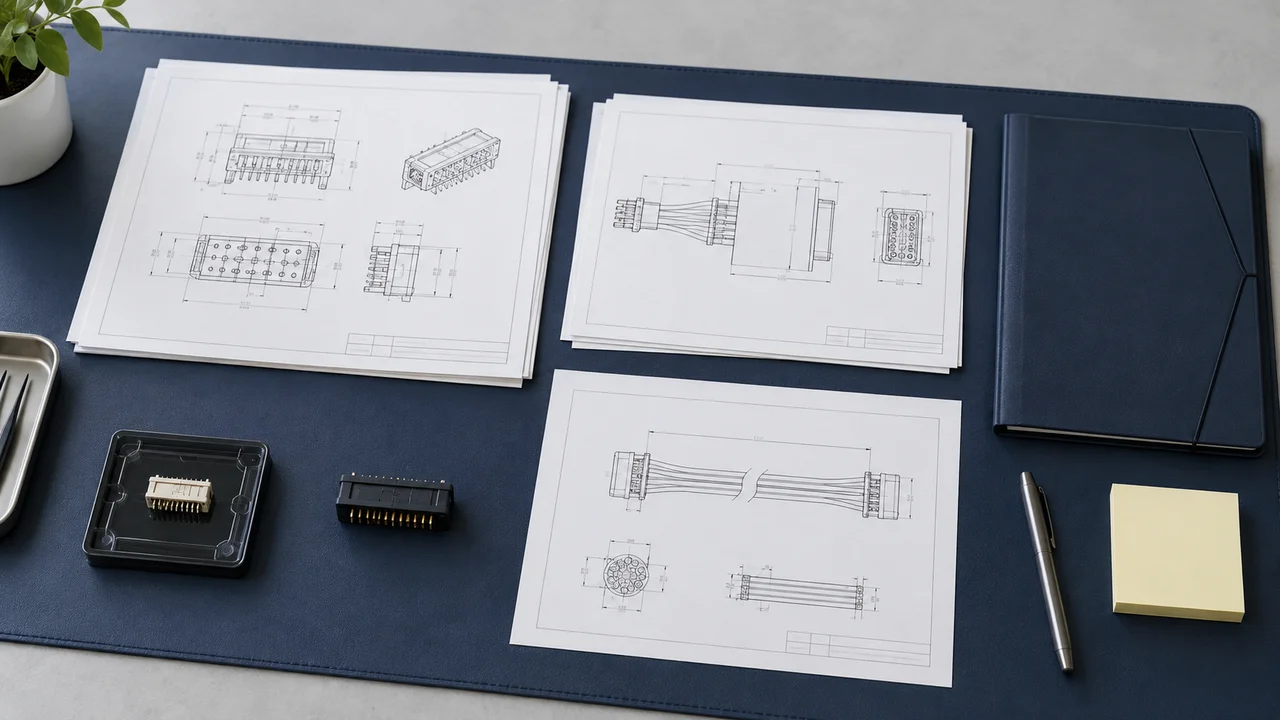
A useful alternative request explains what the existing design must preserve. Sending a part number with “find a cheaper replacement” leaves too many questions unanswered. Include the original component's identity, mating arrangement, operating conditions and permitted changes so that the request can become an actionable assessment. This article focuses on information preparation; the companion connector-alternative guide explains how to compare candidates.
1. Start with a minimum information package
The first discussion does not require an entire project folder. It should, however, include six items: the original manufacturer and complete part number, the application or module, original documentation or reliable drawings, mating-component information, fixed requirements, and required quantities and timing.
When the part number is unknown, provide labels, photographs of both sides and the installed location, clearly marked “part identity to be confirmed.” These materials can help the search, but finding a similar image does not complete either identification or alternative assessment.
Manufacturer documentation shows why full identification matters. Hirose's individual FH12 product page links contact count, pitch and contact position to an exact part number; JST manages housings, contacts and headers separately.[1][2] A series abbreviation or a single component from a larger assembly usually leaves information to be collected.
2. Explain the original design conditions
Where the part is used matters as much as what it is called. Describe the connected modules, power or signals carried, installation position, temperature, handling and mechanical loads. For a wire harness, include wire details and circuit mapping. For an FPC/FFC connection, include mating-end geometry and exposed conductor orientation. For a board-to-board connection, include both parts and the board arrangement.
Also explain what has already been validated in the original design. Share permitted test summaries, known issues or unacceptable failure behavior rather than asking a supplier to guarantee unspecified “equivalent performance.” Evidence from the original part and project is not a test result for the candidate.
State the reason for the request: shortage, second sourcing, a revised sourcing policy, mechanical redesign or a cost target. This can influence the search priorities, but it does not remove the need for technical confirmation and approval.
3. Classify constraints into three groups
Fixed requirements are conditions the candidate must meet, such as an existing PCB footprint, enclosure opening, mating part or customer-approved pin mapping. Negotiable items may change, but the impact must be explained—for example, actuator direction, an assembly step or packaging. Unresolved items have not yet been decided by the responsible person.
Avoid describing negotiable requirements simply as “anything is acceptable.” A more useful instruction is: “Body height may change within the attached envelope; both connector halves may change, but the customer-side harness must remain unchanged.” This defines a real search boundary.
Clarify the meaning of the Chinese-brand or origin requirement and any evidence needed for manufacturing location, source or an approved list. Do not leave the supplier to establish the project's sourcing definition independently.
Alternative-request worksheet
| Information group | Information to provide | Status / owner |
|---|---|---|
| Original identity | Manufacturer, complete part number, internal item code and revision mapping | ______ |
| Project and reason | Module function, reason for substitution, prototype or production stage | ______ |
| Mating system | Opposite connector, cable or harness, and mounting arrangement | ______ |
| Fixed constraints | Footprint, dimensions, pin assignments, interfaces or processes that cannot change | ______ |
| Permitted changes | Adjustable items, allowed ranges and approval requirements | ______ |
| Electrical and environmental | Current, voltage, signals, temperature, loading and operating conditions | ______ |
| Validation | Sample needs, checks, acceptance criteria, owners and target schedule | ______ |
| Commercial targets | Sample and production quantities, forecast, required dates and cost target | ______ |
| Information permissions | Shareable files, permitted use, recipients and confidentiality restrictions | ______ |
This is a suggested template, not a requirement to resolve everything immediately. Mark unknowns “to be confirmed” and identify who will supply the missing information. An unexplained blank invites different assumptions.
4. Organize attachments by purpose and revision
Use a project identifier and give each attachment a clear subject, revision, date and purpose. Where several drawing revisions exist, identify the current design basis and label older versions as historical. Screenshots can help locate a detail, but critical dimensions and conditions need readable context.
| Attachment | Question it helps answer | Check before sharing |
|---|---|---|
| Original datasheet and ordering information | What is the original part, and under what conditions is it specified? | Complete part number, revision and source |
| Mating, mounting and footprint drawings | What are the interface, space and PCB constraints? | Viewing direction, datums and critical tolerances |
| Cable or harness drawing and pin map | How do the mating end, conductors and circuits correspond? | Both mating components and position-1 markings |
| Application conditions and validation summary | What operating conditions and risks matter? | Measured facts separated from planned checks |
| Sample and photograph records | Which physical item and installation are being shown? | Sample identity or lot and orientation labels |
A missing attachment need not stop every discussion, but its impact must be clear. Without the existing PCB layout, a supplier may be able to identify a relevant product range but cannot establish that no board change is needed.
5. Agree sample, validation and approval responsibilities early
Determine who supplies original samples, candidate samples and target mating parts; who performs the checks; who defines acceptance criteria; and who approves introduction. Otherwise, candidates may arrive before a test board, assembly setup or approval owner is available.
Treat a documentation response, sample shipment, completed test and customer approval as separate milestones. Receiving samples is not production approval. A quotation does not confirm requirements that were never stated. Keep conclusions tied to the relevant part numbers and revisions, and reassess affected items when changes occur.
6. Share only the information needed for the assessment
Start with permitted drawings, dimensions and operating conditions relevant to the component rather than disclosing a complete customer design. Share further details after agreeing the purpose, access scope and confidentiality requirements. These are information-management suggestions; actual agreements govern the relationship.
A good alternative request makes clear what cannot change, what can be discussed and what evidence is still missing. When submitting information to MISUXIN, establish the assessment scope and missing inputs before comparing candidates. Pricing, delivery and final application suitability are separate matters to be confirmed.
Related reading
Evaluating Chinese-Brand Connector Alternatives: Mechanical, Electrical and Assembly Checks
How to Prepare a BOM RFQ: Part Numbers, Quantities and Delivery Requirements
References
[1] Hirose, FH12-10S-0.5SH(55) Product Information. Product specifications. Used to illustrate a complete part number, position count, pitch and contact location, not as a selection recommendation or availability statement.
[2] JST, XH Product Page. Product and component lists for housings, contacts and headers; each component must be identified separately.
References accessed September 17, 2026. Product examples illustrate documentation and evaluation methods; they are not part recommendations, interchangeability approvals or supply commitments.