
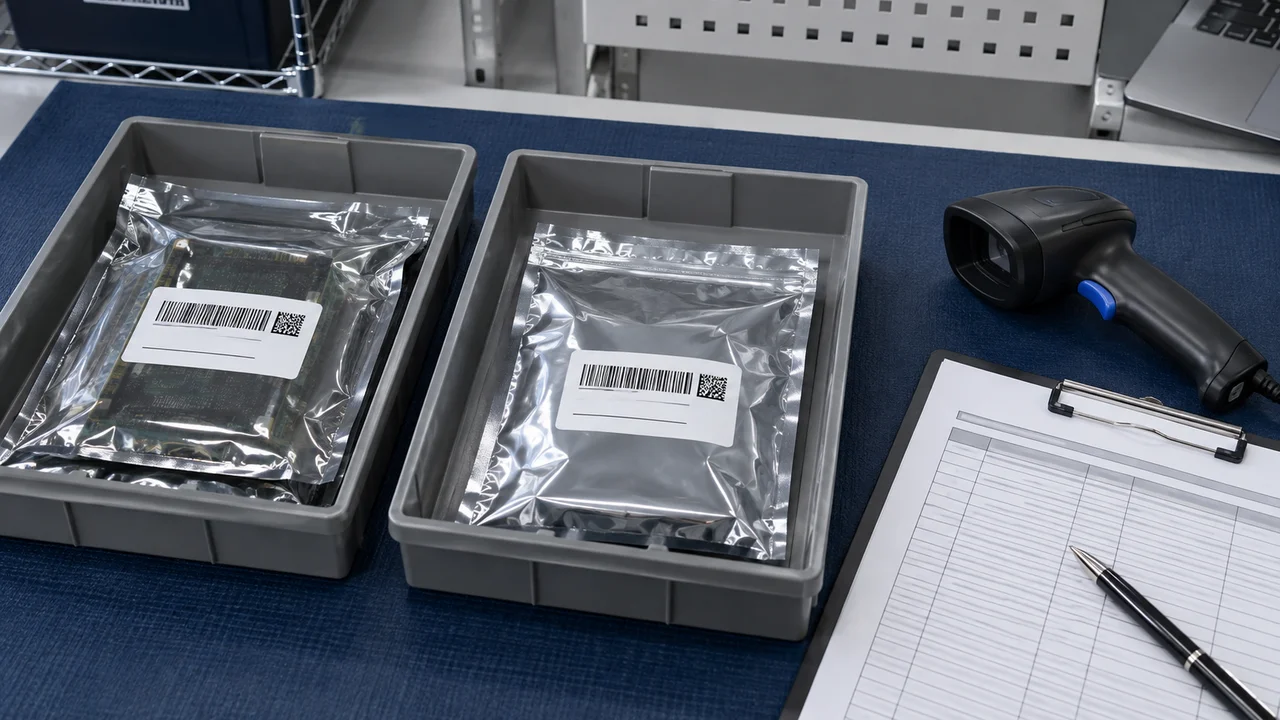
Component traceability requires more than recording a date code. A useful record links part identity, labels, lot or package identifiers, purchasing records and delivery records—and makes clear how far that evidence reaches. Label formats are manufacturer-specific, and a complete set of documents is not, by itself, a guarantee of authenticity or quality.
1. Dates, lots and orders answer different questions
A date code is a date-related identifier whose meaning, format and location must be interpreted using the manufacturer's documentation. A lot or batch identifies a manufacturer-defined production or management grouping. Purchase orders, sales orders and shipping records describe transactions and movement; they do not replace manufacturing-lot records.
TI's General Quality Guidelines discuss lot traceability, container tracking identifiers and date codes separately. They state that the manufacturing date code on labels or shipping documentation serves inventory management and is not an indicator of product quality.[1] Identical date information alone therefore does not establish the complete source relationship between two groups of parts.
Do not decode every four-digit field automatically as a year and week. Likewise, a receipt, repacking or label-printing date should not be treated as the manufacturing date. When the meaning is unclear, preserve the original field and label image and seek clarification from the manufacturer or a supplier able to explain it reliably.
2. A date code is not a universal expiration date
An older date may require further review against project requirements, but it does not alone establish that a component has failed. TI's storage guidance identifies factors including materials, manufacturing conditions, moisture sensitivity, packaging, moisture protection and customer storage conditions.[2] This is not an endorsement of all older inventory; it explains why age is only one part of the assessment.
A buyer may still specify acceptable date ranges, packaging or storage evidence for a project. State those as explicit purchasing conditions and confirm whether the supplier can meet them. Material with incomplete evidence may need further assessment, while a recent label date does not automatically eliminate sourcing or handling risk.
3. Agree documentation requirements before ordering
Confirm accompanying documents for each order. Different products, sources and suppliers may not provide the same records. Establish who issues each document, which parts or lots it covers, and what inspection or declaration it actually represents.
For a conformity document, check the issuer and scope. For a test report, check the sample identity, methods, conditions and identifiers linking it to the material. Neither should be presented as evidence for every unit, risk or operating condition outside its scope. TI also distinguishes supply-source risks and support boundaries for unauthorized channels; a label or single document does not replace source evaluation.[1]
Documentation checklist
| Document or record | Confirm before ordering | What it does not automatically establish |
|---|---|---|
| Original packaging-label information | Part number, quantity, date or lot fields, and available record format | Authenticity based only on label appearance |
| Packing list and delivery records | Order-line, quantity, package and lot relationships | Access to complete factory production records |
| Conformity document / CoC | Issuer, part number, scope and covered delivery | Independent testing of every characteristic |
| Test report | Sample identity, tests, conditions, date and result scope | Inspection of every unit or compliance with every requirement |
| Material or environmental declaration | Covered part, version, issuer and supporting basis | Compliance of the complete equipment with all applicable requirements |
| Storage or repacking records | Required records, actual coverage and availability | Original sealed status merely because packaging looks new |
4. Preserve relationships when splitting and repacking material
When a reel, bag or box is split, retain a link from each new package to the original package. A useful record includes the original identifier, new package identifier, quantity removed, quantity remaining, operation date and destination. Avoid merging different lots or sources into indistinguishable stock simply because the part number is the same.
For an illustrative quantity split, incoming package R001 contains 1,000 pieces. A shipment removes 300 pieces for Order A, leaving 700 pieces. The records should connect both the 300 shipped pieces and the remaining 700 to R001 and its original label information. R001 is an example internal package identifier—not a manufacturer's lot number or an individual component serial number.
This preserves the movement relationship. If the original evidence contains no manufacturing lot, an internal identifier cannot create one. A label photograph alone should not be described as complete manufacturer traceability.
5. Use a record structure that reflects the available evidence
| Record group | Suggested information | Action when information is missing |
|---|---|---|
| Part identity | Manufacturer, complete part number, internal code and revision | Leave identity unresolved and obtain evidence |
| Original identifiers | Unchanged label fields, date code and lot or container ID where available | Preserve the original text; do not guess the decoding |
| Transaction links | Supplier, purchase order, receipt and sales or delivery line | Identify and investigate the break in the record |
| Packages and quantities | Original package, split packages and quantity movements | Keep packages distinguishable; avoid uncontrolled merging |
| Document links | Declaration or report number and its coverage | Record missing documents or scope mismatches |
| Review and disposition | Discrepancies, reviewer, conclusion and release status | Keep unresolved material pending disposition |
Adjust the structure to the product risk and actual process. Where records reach the supplier, purchase order and customer order, describe that scope accurately. Extend the traceability claim upstream only when the corresponding evidence has been obtained and verified.
6. Preserve evidence when a discrepancy appears
If part numbers, quantities, labels or documents do not align, keep the material separate, retain its original packaging and photographs, and record the discrepancy before contacting the supplier. Do not overwrite a date code or original label field merely to make the system entries agree.
Decisions on continued use, additional inspection, return, replacement or re-sourcing should reflect the discrepancy and project requirements. Traceability is valuable because it shows where evidence comes from, where material goes and where information is missing—not because every field contains a value. Defining lot, packaging and documentation needs before purchase makes later verification more practical.
When requesting a quotation from MISUXIN, include date-code or lot preferences, original-label needs and accompanying-document requirements. Availability of these records should be confirmed for the specific part, source and order.
Related reading
How to Prepare a BOM RFQ: Part Numbers, Quantities and Delivery Requirements
How to Prepare a Request for Chinese-Brand Component Alternatives
References
[1] Texas Instruments, General Quality Guidelines. Revision Q, April 15, 2025; pp. 9–10, sections 25, 27 and 29: traceability, date codes and labels; p. 4, section 8: sourcing risk. These descriptions are specific to TI.
[2] Texas Instruments, Quality, Reliability and Packaging FAQs. Product shelf-life section: storage conditions, packaging, moisture protection and date information. No baking parameters are reproduced here.
References accessed September 17, 2026. Product examples illustrate documentation and evaluation methods; they are not part recommendations, interchangeability approvals or supply commitments.